Overview
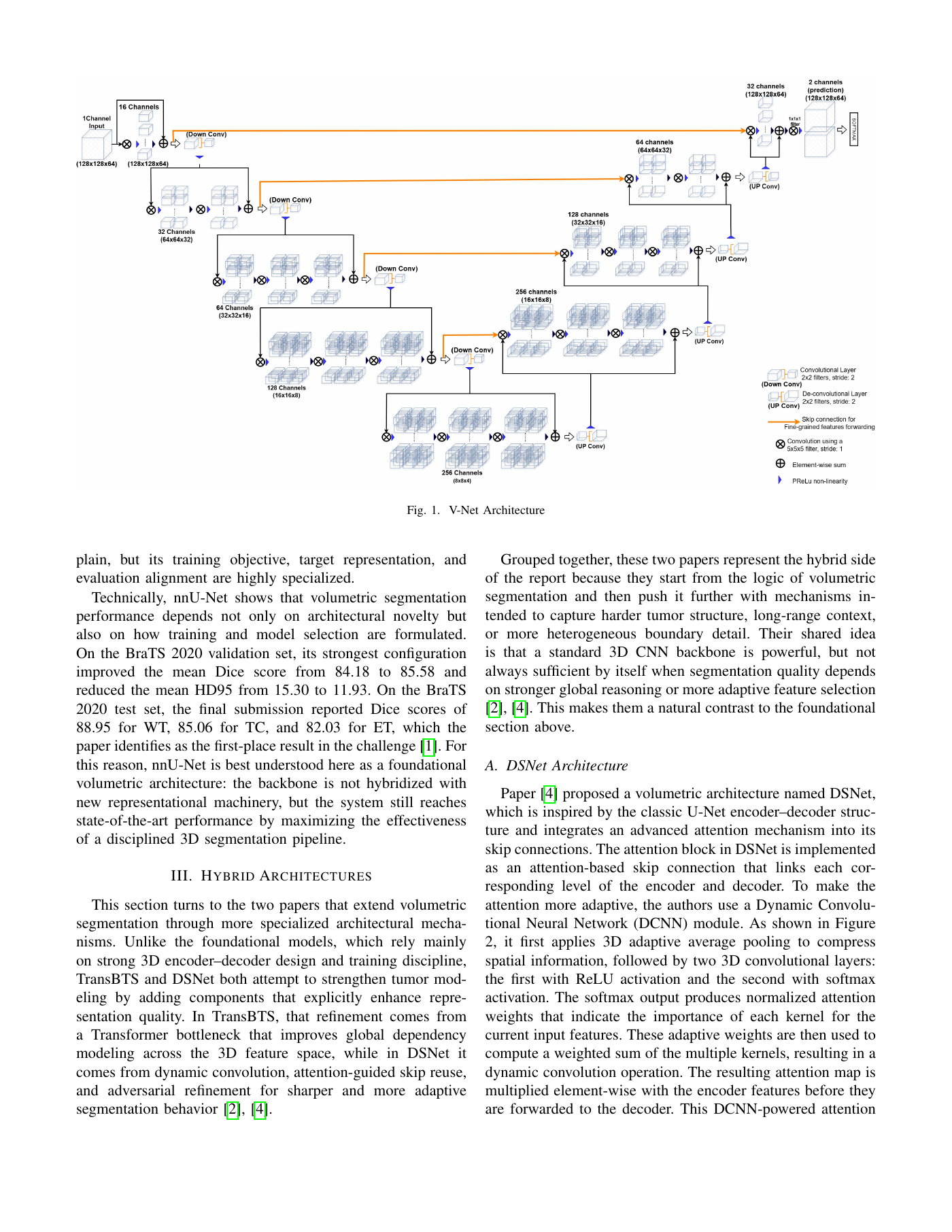
This report analyzes brain tumor segmentation from multimodal MRI through two architecture groups. V-Net and nnU-Net represent strong volumetric encoder-decoder foundations, while TransBTS and DSNet show hybrid approaches that add transformers, dynamic convolution, attention, and adversarial refinement.
Key Features
- Explains why 3D volumetric segmentation improves over slice-only processing for tumor shape and continuity.
- Compares foundational models that emphasize stable encoder-decoder design and Dice-aware optimization.
- Analyzes hybrid designs that add global reasoning, dynamic filtering, and attention-guided skip reuse.
- Frames model improvements against memory cost, complexity, training stability, and clinical extensibility.
Evidence
Interactive Slide Deck
Tumor Segmentation Presentation
Slide 1 of 22
The main takeaway is that newer tumor segmentation models tend to build on strong 3D encoder-decoder foundations rather than replacing them. Hybrid mechanisms can add capacity, but they also raise compute, memory, and training-complexity costs.

