Overview
This project was designed to demonstrate a working understanding of foundational AI algorithms through hands-on implementation, analysis, and experimentation. The key constraint was educational: build the algorithms directly in Python and NumPy instead of hiding the learning process behind high-level machine-learning frameworks.
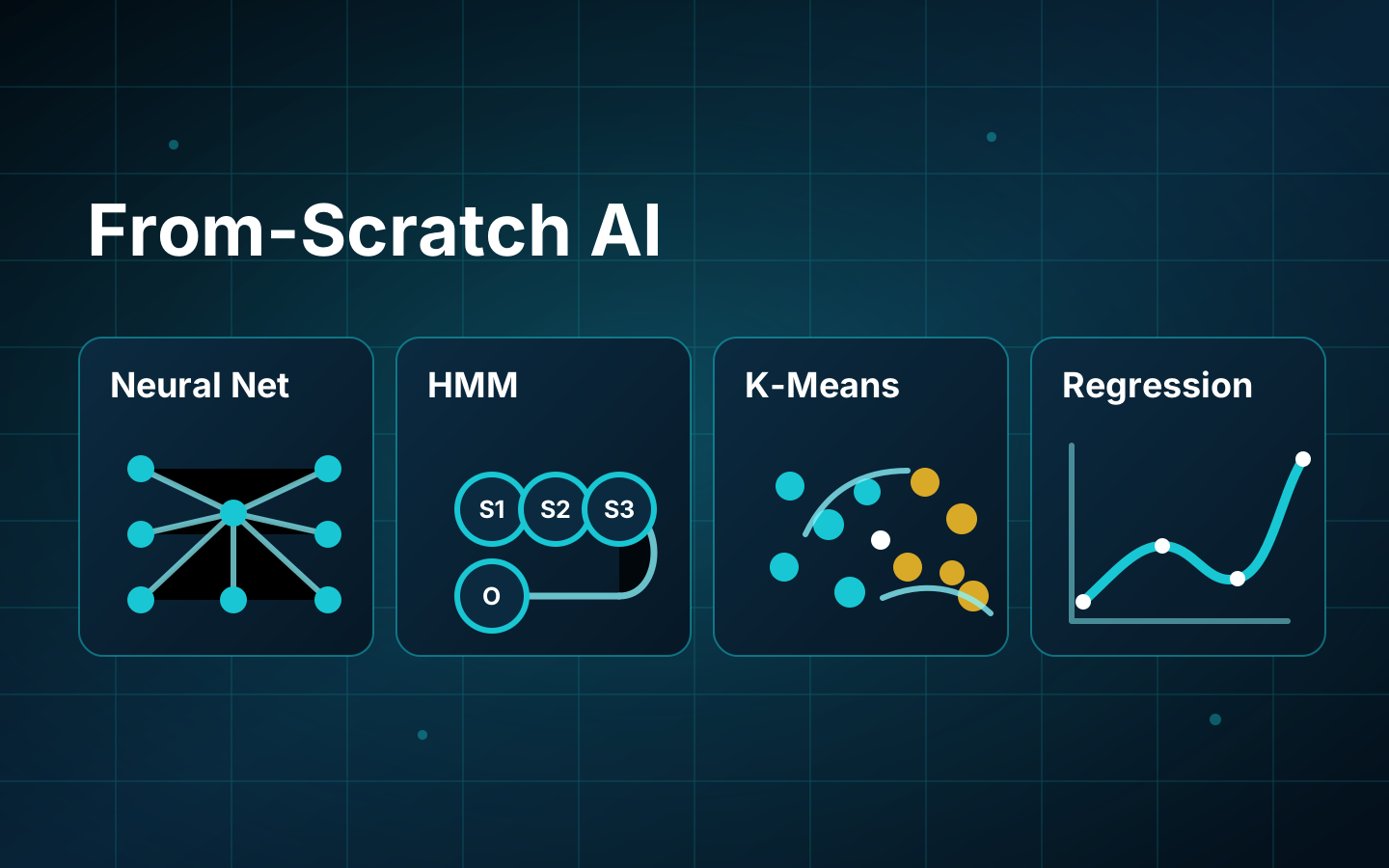
The result is a portfolio of algorithm implementations covering neural networks, probabilistic sequence models, unsupervised clustering, and regression. The project shows the mathematical mechanics behind model behavior, convergence, limitations, and debugging.
Implemented Algorithms
- Neural networks from scratch: feed-forward architecture, custom activation functions, forward propagation, backpropagation, weight initialization, and training dynamics.
- Hidden Markov models: state transitions, emission probabilities, forward and backward algorithms, sequence likelihood, and temporal probabilistic modeling.
- K-means clustering: centroid initialization, distance-based assignment, centroid updating, convergence behavior, and clustering limitations.
- Regression analysis: linear and polynomial regression, parameter estimation, error minimization, model evaluation, and interpretation.
Learning Objectives
- Reinforce core AI algorithmic concepts and mathematical foundations.
- Practice probabilistic reasoning and inference with temporal data.
- Evaluate model behavior, limitations, and performance tradeoffs.
- Debug and validate numerical methods directly instead of relying on framework abstractions.
- Use visualization to inspect convergence, error behavior, and learned structure.
Why It Matters
This project complements my applied AI work by showing that I can reason about what machine-learning libraries are doing under the hood. That is useful for teaching, troubleshooting, model evaluation, and explaining AI behavior to technical and non-technical audiences.
The public repository contains the implementation work, and the deployed Streamlit app provides an interactive way to inspect and demonstrate the algorithms.


What I Learned
Building these algorithms manually made the tradeoffs clearer: initialization affects training behavior, convergence is not guaranteed just because the math is correct, probabilistic models require careful bookkeeping, and visualization is often the fastest way to catch incorrect assumptions.